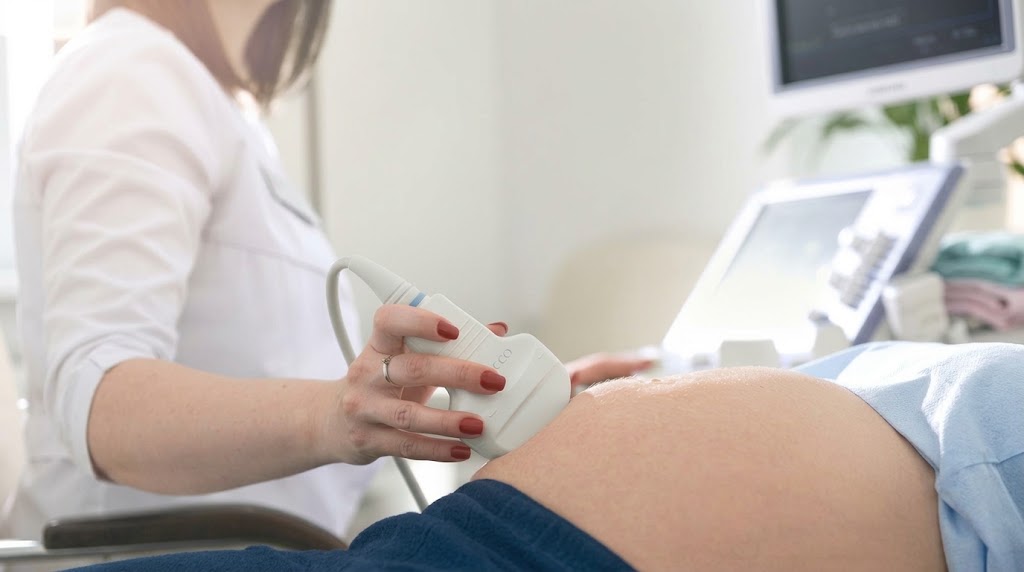
An early pregnancy scan can provide important information about the location, gestational age and early development of a pregnancy. Non-Invasive Prenatal Testing (NIPT) is a separate blood-based screening test that assesses the likelihood of certain chromosomal conditions.
Although both may form part of prenatal care, an ultrasound and NIPT answer different questions and are not interchangeable. Importantly, NIPT is a screening test, not a diagnostic test.
You may also see NIPT described by some providers as non-invasive chromosomal screening or checking.
What Is an Early Pregnancy Scan?
An early pregnancy scan is an ultrasound performed during the first trimester to assess the pregnancy. Depending on the gestational age and reason for the scan, it may help to:
- Confirm that the pregnancy is located within the uterus
- Estimate gestational age and expected due date
- Assess early pregnancy development
- Assess fetal viability when appropriate for the gestational age
- Determine whether there is more than one pregnancy
- Identify findings that may require further assessment or follow-up
What can be seen on ultrasound depends greatly on how far along the pregnancy is. A very early scan may not yet show all the findings expected later in the first trimester.
What Happens at Your First Pregnancy Visit?
After a positive pregnancy test, your doctor may review the first day of your last menstrual period to estimate your gestational age and expected due date. Your medical history, previous pregnancies, current medications and supplements will also be reviewed.
Depending on how far along you are, an ultrasound may be arranged to assess the location and development of the pregnancy. Your doctor can also discuss folic acid supplementation, antenatal booking and which prenatal screening options may be appropriate later in the first trimester.
When Should You Have an Early Pregnancy Scan?
Once you have a positive pregnancy test, the appropriate timing of your first ultrasound depends on your gestational age, symptoms, medical history and the reason for the scan.
Around 5–6 weeks:
An ultrasound may help confirm that the pregnancy is located within the uterus. Depending on the exact gestational age, a gestational sac and yolk sac may be visible. However, it may still be too early to reliably see an embryo or cardiac activity.
Around 6–8 weeks:
An ultrasound can usually provide more information about pregnancy location, dating, the number of pregnancies and fetal viability. Cardiac activity may be visible when expected for the gestational age.
Around 11–13+6 weeks:
First-trimester ultrasound can provide further assessment of pregnancy dating and early fetal development. Depending on your individual pregnancy and the services available, additional first-trimester screening may also be discussed.
An earlier assessment may be recommended if you experience vaginal bleeding, significant abdominal or pelvic pain, have a history of ectopic pregnancy, conceived through fertility treatment, or have another medical or pregnancy-related concern.
If an ultrasound is performed very early and the expected findings are not yet visible, this does not necessarily mean that the pregnancy is abnormal. Your doctor may recommend a repeat ultrasound and/or blood tests when clinically appropriate.
When Should You Seek Medical Attention Earlier?
While mild symptoms can occur during early pregnancy, seek medical assessment if you experience symptoms such as significant or worsening abdominal or pelvic pain, heavy vaginal bleeding, dizziness or fainting, shoulder-tip pain, or feeling significantly unwell.
These symptoms may require earlier assessment to exclude complications such as an ectopic pregnancy or significant bleeding.
When Should You Open Your Pink Book?
Once your pregnancy is confirmed, you can arrange your antenatal booking or “Pink Book” appointment at your local Klinik Kesihatan or Klinik Kesihatan Ibu dan Anak (KKIA).
The Ministry of Health Malaysia recommends starting antenatal care as early as possible, preferably before 12 weeks of pregnancy.
Your first antenatal booking visit is an important part of pregnancy care and may include a review of your medical and pregnancy history, routine examinations, blood and urine tests, and assessment of any pregnancy risk factors.
You do not need to wait until NIPT or other prenatal screening has been completed before opening your Pink Book.
What Is NIPT or NICC?
NIPT (Non-Invasive Prenatal Testing) is a blood-based prenatal screening test. It analyses cell-free DNA circulating in the mother’s blood, including DNA originating from the placenta, to estimate the likelihood of certain chromosomal conditions.
Some healthcare providers or laboratories may use terms such as non-invasive chromosomal screening or checking (NICC) when referring to these tests.
Most importantly:
NIPT is a screening test, not a diagnostic test.
A high-risk result does not by itself confirm that the baby has a chromosomal condition. Further assessment, genetic counselling and diagnostic testing may be recommended depending on the result and clinical circumstances.
What Can NIPT Screen For?
Most standard NIPT panels screen for common chromosomal conditions including:
- Trisomy 21 (Down syndrome)
- Trisomy 18 (Edwards syndrome)
- Trisomy 13 (Patau syndrome)
Depending on the test, some panels may also screen for certain sex chromosome conditions or other chromosomal findings.
However, not every NIPT package screens for the same conditions, and a broader panel does not necessarily mean that it is a better or more appropriate test for every pregnancy.
Your doctor can help you understand what is included in the particular test being considered.
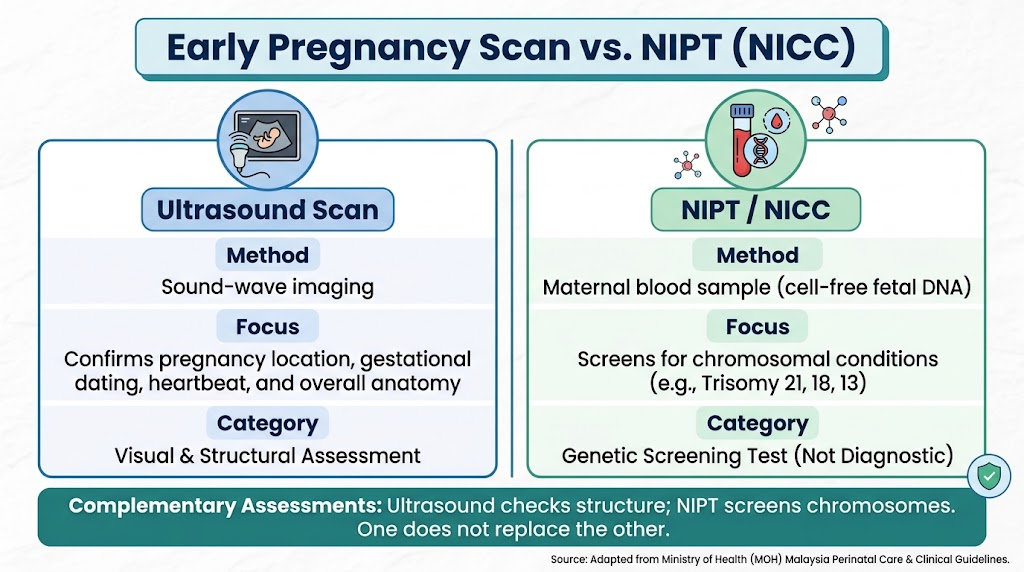
Early Pregnancy Scan vs NIPT: What’s the Difference?
| Early Pregnancy Scan | NIPT |
| Uses ultrasound | Uses a maternal blood sample |
| Assesses pregnancy location and fetal development depending on gestational age | Screens for selected chromosomal conditions |
| May identify certain structural findings depending on gestational age and scan type | Does not replace ultrasound |
| Non-invasive | Non-invasive |
| Not a genetic diagnostic test | Screening test, not diagnostic |
Key message:
An ultrasound and NIPT answer different questions, so one does not replace the other.
When Is NIPT Usually Done?
NIPT can be performed from 10 weeks of pregnancy onwards and is commonly done during the first trimester, around 10–12 weeks.
Before or around the time of testing, an ultrasound may be used to confirm the pregnancy’s gestational age, viability and number of fetuses.
Unlike certain first-trimester ultrasound screening assessments, NIPT is not limited to the 11–13+6-week period and can be performed later in pregnancy. However, earlier screening allows more time for appropriate counselling and further assessment if a high-risk result is identified.
The exact timing and suitability may depend on the NIPT or NICC test used and the individual pregnancy.
What Happens During an NIPT Appointment?
NIPT involves a blood sample taken from the mother. Before testing, your doctor will review your gestational age and pregnancy history and explain what the selected NIPT panel screens for.
Once the laboratory result is available, it should be interpreted together with your pregnancy history and relevant ultrasound findings. If the result is reported as high-risk or inconclusive, further assessment may be recommended.
Does a Low-Risk NIPT Result Mean Everything Is Normal?
A low-risk NIPT result means that the chance of the chromosomal conditions screened for is reduced, but not eliminated.
NIPT only screens for the specific conditions included in that particular test. It cannot detect every genetic condition or birth defect and does not replace routine antenatal care or recommended ultrasound assessment.
A low-risk result is therefore reassuring, but it is not a guarantee that the baby has no genetic or structural condition.
What If NIPT Shows a High-Risk Result?
A high-risk NIPT result does not automatically mean that the baby has the condition.
Because NIPT is a screening test, your doctor may recommend further assessment, which may include:
- Genetic counselling
- Referral to an obstetric or maternal-fetal medicine specialist
- A detailed ultrasound assessment
- Diagnostic testing, where appropriate, such as chorionic villus sampling (CVS) or amniocentesis
Diagnostic testing may be required to determine whether the chromosomal condition is actually present.
MOH Malaysia specifically distinguishes non-invasive screening from invasive prenatal diagnostic procedures such as CVS and amniocentesis in its thalassaemia guidance.
How Do You Choose the Right Pregnancy Screening?
There is no single screening plan that is right for every pregnancy. Your doctor may consider factors such as:
- Your gestational age
- Your medical and pregnancy history
- Previous pregnancy or genetic concerns
- Family history where relevant
- What conditions a particular NIPT panel actually screens for
- Which ultrasound assessments are appropriate at your stage of pregnancy
- What further assessment would be recommended if a screening result is high-risk
- Whether genetic counselling or specialist referral may be appropriate
More testing is not necessarily better. The aim is to choose appropriate assessments based on your individual pregnancy.
What Comes Next in Your Pregnancy?
Pregnancy care continues beyond your early pregnancy scan and NIPT. While your individual care plan may vary, a general pregnancy timeline may include:
| Pregnancy Stage | Common Assessment |
| Positive pregnancy test | Pregnancy confirmation and initial pregnancy consultation |
| Around 6–8 weeks | Early pregnancy, dating and viability scan |
| As early as possible, preferably before 12 weeks | Antenatal registration / Pink Book |
| From 10 weeks onwards | NIPT, if chosen |
| 11–13+6 weeks | First-trimester assessment / NT scan where appropriate |
| 18–22 weeks | Detailed fetal anatomy / anomaly scan |
| 24–28 weeks | Gestational diabetes screening for most pregnancies |
Your individual pregnancy timeline may differ depending on your medical history, previous pregnancies and findings during antenatal care.
Early Pregnancy Scan & NIPT in Malaysia
Early pregnancy scans and NIPT are available in Malaysia as part of antenatal and prenatal care. The most appropriate assessments will depend on your gestational age, medical history, pregnancy history and individual screening needs.
At Klinik Central, our doctors can review your pregnancy history, arrange appropriate early pregnancy assessments and discuss available prenatal screening options, including NIPT.
Where further assessment is required, referral to an obstetrician or maternal-fetal medicine specialist may be recommended.
As your pregnancy progresses, other antenatal assessments may also be recommended, including a detailed fetal anatomy scan and screening for gestational diabetes.
A Reassuring Start to Your Pregnancy Journey
The first few weeks of pregnancy can come with plenty of excitement — and plenty of questions about which scans and tests you actually need.
An early pregnancy scan and NIPT serve different purposes. Ultrasound provides information about the pregnancy itself, while NIPT screens for the likelihood of certain chromosomal conditions.
Understanding what each assessment can and cannot tell you can make pregnancy screening much less overwhelming.
Your doctor can help you decide which assessments are appropriate based on your gestational age, medical history and individual pregnancy.
The goal is not to have every test available, it is to have the right tests for you and your pregnancy.