STI screening is an important part of sexual health for men, especially after a new sexual partner, unprotected sexual contact, or possible exposure to a sexually transmitted infection (STI).
Many STIs can cause no symptoms, so feeling well does not always mean that an infection is absent. A sexual health consultation allows a doctor to assess your individual risk, discuss appropriate tests, and advise you on prevention and follow-up.
This approach is consistent with the Malaysia Guidelines on the Management of Sexually Transmitted Infections, Fifth Edition 2024, published by the Ministry of Health Malaysia (KKM).
What Is STI Screening?
STI screening involves testing for sexually transmitted infections based on your symptoms, sexual history, possible exposures, and individual risk factors.
Depending on the situation, screening may include tests for:
- HIV
- Syphilis
- Hepatitis B
- Hepatitis C
- Chlamydia
- Gonorrhoea
Not everyone needs exactly the same tests. KKM recommends that STI screening should be guided by the individual’s sexual practices, symptoms and exposure history.
What STI Tests May Be Recommended for Men?
KKM guideline lists blood tests for:
- HIV Ag/Ab
- Syphilis serology
- Hepatitis B surface antigen (HBsAg)
- Hepatitis C antibody (Anti-HCV)
A urine test using nucleic acid amplification testing (NAAT) may be used to test for chlamydia and gonorrhoea. Additional testing may be considered depending on sexual practices. For example, a throat swab or rectal swab may be appropriate following relevant oral or anal sexual exposure.
This is why a “one-size-fits-all” STI package may not always be appropriate for every person.
When Should You Get an STI Test?
You may wish to discuss STI screening with a doctor if you:
- Have had sexual intercourse without a condom
- Have had more than one sexual partner
- Have symptoms that could be related to an STI
- Have been informed that a sexual partner has an STI
- Are concerned about a recent sexual exposure
- Want to check your sexual health after a period of uncertainty
It is also important to consider when the exposure happened.
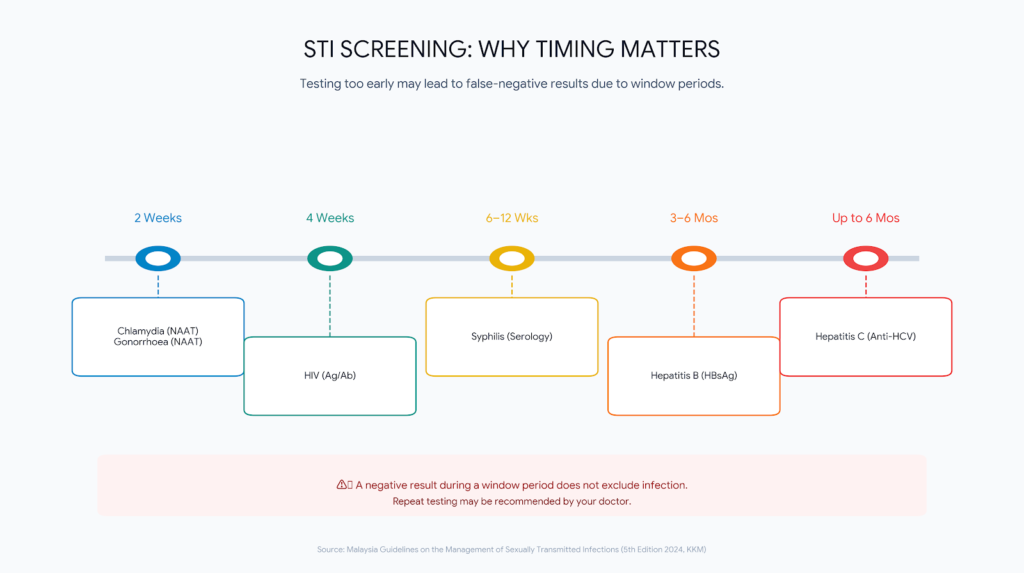
STI Screening: Why Timing Matters
A test performed too soon after exposure may not detect an infection because of the window period.
According to the KKM STI guideline, approximate window periods include:
| Infection | Approximate window period |
| Chlamydia – NAAT | 2 weeks |
| Gonorrhoea – NAAT | 2 weeks |
| HIV Ag/Ab | 4 weeks |
| Syphilis – serology | 6–12 weeks |
| Hepatitis B | 3–6 months |
| Hepatitis C | Up to 6 months |
These are important when interpreting a negative result after a recent exposure. Depending on the timing and circumstances, your doctor may recommend repeat testing. A negative result does not necessarily exclude an infection if testing was performed during the relevant window period.
What If You Have Symptoms?
Do not wait for routine screening if you develop symptoms.
Men with possible STI-related symptoms may experience:
- Penile or urethral discharge
- Pain or burning when urinating
- Genital skin changes; sores or ulcers
- Testicular pain or swelling
- Anal or perianal symptoms
- Other unusual genital symptoms
However, some STIs may cause no symptoms at all. This is why testing may still be appropriate even when you feel completely well. KKM recommends reviewing specific genital and sexual symptoms as part of the STI consultation.
What Happens If Your STI Test Is Positive?
A positive result does not mean you should panic.
Your doctor can explain what the result means, whether further testing is required, and what treatment or follow-up is appropriate.
Depending on the infection, sexual partner notification and management may also be important to reduce the risk of reinfection and further transmission.
Your doctor can also discuss safer sex practices and prevention strategies. The KKM guideline includes counselling, discussion of STI transmission and offering condoms as part of the consultation process.
Confidential STI Screening in Malaysia
Sexual health information is sensitive, and patients may understandably have concerns about privacy.
During a consultation, you can discuss your concerns and sexual history with your doctor so that appropriate testing and advice can be provided. Healthcare professionals are expected to maintain patient confidentiality, subject to applicable legal and professional requirements.
If you are worried about discussing a particular exposure, you can tell the doctor that you would prefer to discuss it privately.
What Happens During the Consultation?
An STI consultation is usually more than simply taking a blood test.
Your doctor may ask about:
- When the possible exposure occurred
- Whether you have a new or multiple sexual partners
- Whether condoms were used
- The type of sexual contact, such as vaginal, oral or anal intercourse
- Previous STIs or previous STI testing
- Any symptoms you may have
- Whether a sexual partner has been diagnosed with an STI
- Any concerns about HIV or other infections
These questions help your doctor determine which tests are appropriate. KKM’s STI guideline specifically recommends taking a relevant sexual history and asking about previous STIs, partners, recent sexual contacts and symptoms
You Don’t Need to Feel Embarrassed
Sexual health questions can sometimes feel uncomfortable, but they are a routine part of medical care.
Giving your doctor accurate information helps determine which tests you actually need. You do not need to know the medical terminology or decide which STI tests to take yourself.
The consultation is an opportunity to discuss your concerns privately and ask questions without judgement.
How Can Men Reduce Their STI Risk?
STI prevention can include:
- Using condoms correctly and consistently
- Reducing exposure to untreated STIs
- Getting tested when appropriate
- Seeking medical care when symptoms develop
- Ensuring sexual partners are appropriately assessed and treated when an STI is diagnosed
- Discussing vaccination where relevant, such as hepatitis B vaccination.
Your doctor can help determine which prevention measures are appropriate based on your individual circumstances.
Take the Guesswork Out of Your Sexual Health
STI screening does not have to be complicated or embarrassing. The right tests depend on your symptoms, sexual practices, timing of exposure and individual risk.
If you are concerned about a recent sexual exposure or simply want to check your sexual health, speaking with a doctor can help you understand which tests are appropriate, when to test, and what to do with the results.
Where Can You Get STI Screening Done?
Klinik Central SS15 and Klinik Central Taman Megah provide a private consultation with a doctor.
During the consultation, the doctor can discuss your symptoms, sexual health concerns, possible exposure and the type of screening that may be appropriate for you. If you are unsure which tests you need, you can discuss your concerns with the doctor before proceeding with testing.
Klinik Central also offers Men’s Health Screening and Men’s Hormone Screening packages for men who would like to assess other aspects of their health beyond STI screening.
These screenings are separate from STI testing and may include investigations related to general health or hormone status depending on the selected package and your individual needs.
You can also have a look at our other health screening packages here!
Frequently Asked Questions
1. Can I have an STI without symptoms?
Yes. Some STIs may not cause noticeable symptoms, which is why testing may be appropriate after certain exposures.
2. What STI tests should men take?
There is no single test that is suitable for every man. KKM recommends selecting tests according to symptoms, sexual practices and exposure risk. Testing may include blood tests for HIV, syphilis, hepatitis B and hepatitis C, together with urine or other site-specific NAAT testing for chlamydia and gonorrhoea where appropriate.
3. Can I test immediately after sex?
Testing immediately after exposure may be too early for some infections. Window periods differ between infections, so your doctor may recommend testing at an appropriate time and repeating the test when necessary.
4. Do I need an STI test if I feel completely healthy?
Possibly. Some STIs can be asymptomatic. Whether screening is appropriate depends on your sexual history and potential exposure.
5. Where can I get an STI screening in Malaysia?
STI screening can be discussed with healthcare professionals at appropriate healthcare facilities, including clinics providing sexual health services.