The HPV test is now the main way Malaysia screens women for cervical cancer, replacing the Pap smear as the first-line test for women aged 30 to 65. The Ministry of Health Malaysia piloted free HPV self-sampling in 2019 and adopted it fully as primary screening in 2023.
Many women still ask for a Pap smear because it is the test they know. Both tests help prevent cervical cancer, but they look for different things and suit different ages. This guide explains how they differ, which one KKM recommends for you, and what your results mean.
Cervical Cancer in Malaysia: The Numbers
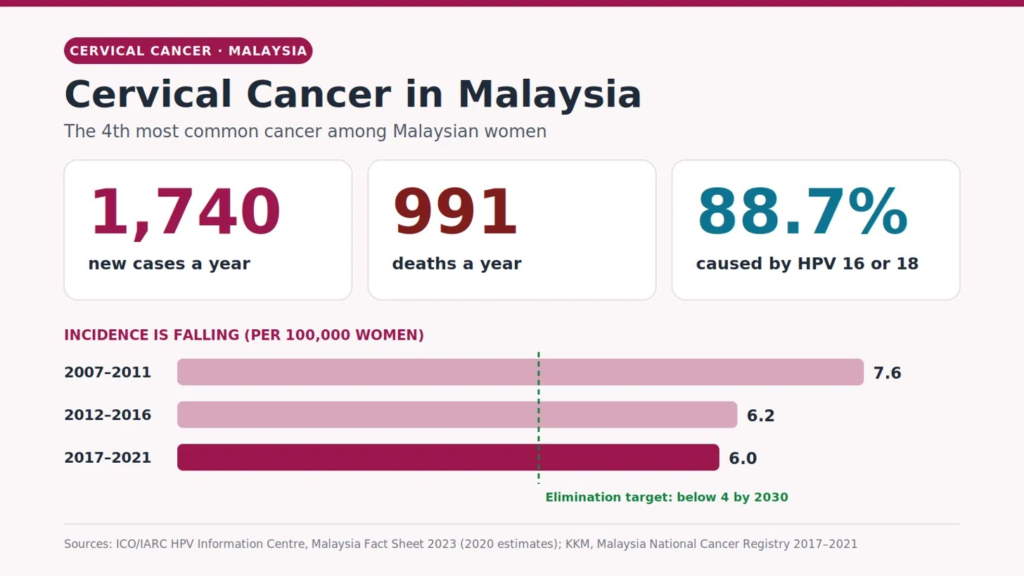
About 1,740 Malaysian women are diagnosed with cervical cancer each year, and about 991 die from it. It is the 4th most common cancer among Malaysian women, and the 2nd most common among women aged 15 to 44.
| Key figure | Value |
| New cases per year | about 1,740 |
| Deaths per year | about 991 |
| Cancers caused by HPV types 16 or 18 | 88.7% |
| Incidence, 2007–2011 | 7.6 per 100,000 women |
| Incidence, 2012–2016 | 6.2 per 100,000 women |
| Incidence, 2017–2021 | 6.0 per 100,000 women |
The good news is that the rate is falling. The goal is elimination, defined as fewer than 4 cases per 100,000 women. KKM’s action plan aims for this by 2030 with three targets:
• 90% of 13-year-old girls vaccinated against HPV
• 70% of women aged 30 to 65 screened with an HPV test
• 90% of women with precancerous changes treated
Screening is where many women fall behind. Cervical cancer usually causes no symptoms in its early stages, so a screening test is often the only way to catch it in time.
Pap Smear vs HPV Test: What’s the Difference?
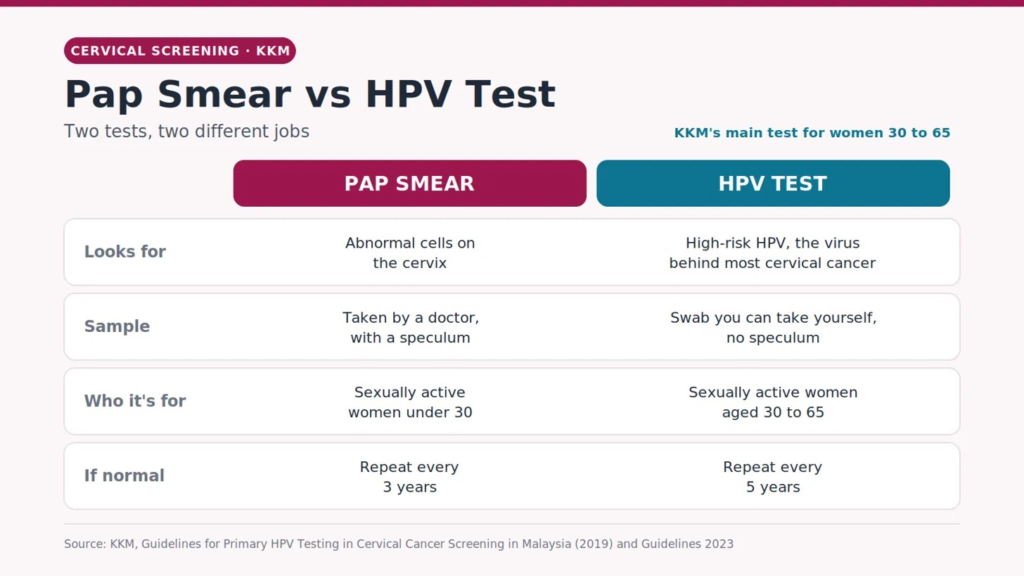
A Pap smear looks for abnormal cells that have already formed on the cervix. An HPV test looks for the virus that causes those cells to change, so it can flag risk years earlier.
| Pap smear | HPV test | |
| What it detects | Abnormal or precancerous cells on the cervix | High-risk HPV types, the virus behind most cervical cancers |
| How the sample is taken | A doctor or nurse uses a speculum and a small brush to collect cells | A soft swab, often collected by the woman herself (self-sampling), or by a doctor |
| Who KKM recommends it for | Women under 30 who are sexually active | Sexually active women aged 30 to 65 |
| How often (if normal) | Every 3 years | Every 5 years |
| Main advantage | Shows whether cells have already changed | Finds risk earlier and more reliably |
KKM’s guideline notes that HPV DNA testing has been shown to be more effective than cervical cytology (the Pap smear) at detecting precancerous changes. The two tests also work together. If an HPV test finds certain high-risk types, a cell test is done on a cervical sample to check for changes.
HPV Test or Pap Smear: What KKM Recommends for Your Age
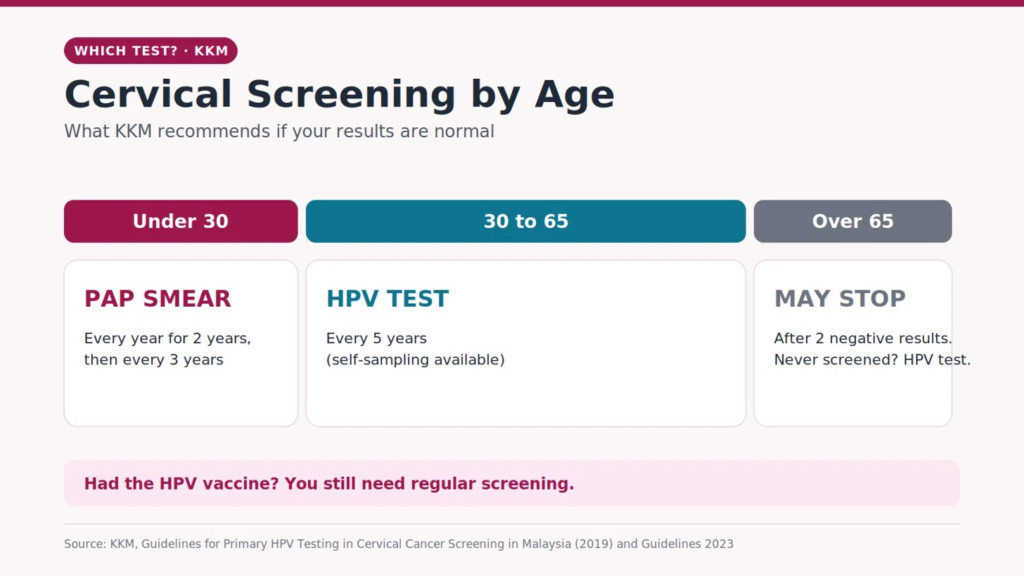
Under KKM’s Guidelines for Cervical Cancer Screening in Malaysia 2023, the HPV test is recommended for sexually active women aged 30 to 65, and women under 30 can be offered a Pap smear.
| Your age | Recommended test | How often if your result is normal |
| Under 30 (sexually active) | Pap smear | Every year for the first 2 years, then every 3 years |
| 30 to 65 | HPV test | Every 5 years |
| Over 65, regularly screened | Screening may stop | Once you meet KKM’s exit criteria, including two negative results. Ask your doctor. |
| Over 65, never screened | HPV test | Ask your doctor |
In Malaysia, the HPV test is used as the first screening test, not only as a follow-up to an abnormal Pap smear. You still need screening if you have had the HPV vaccine, because the vaccines do not cover every high-risk HPV type. Your doctor may also advise more frequent checks if you have a weakened immune system or a history of abnormal results.
HPV Self-Sampling: Quick, Private and No Speculum
With an HPV self-test, you collect the sample yourself in a private room. No speculum is needed. KKM’s guideline describes five simple steps:
1. Remove the swab. Twist the cap to loosen the swab from its plastic tube.
2. Get comfortable. Undress from the waist down and find a comfortable position.
3. Insert the swab. Gently insert it into the vagina up to the marked line.
4. Take the sample. Rotate the swab gently 10 times.
5. Return the swab. Put it back in the tube, close it tightly and hand it to the nurse.
If you are not comfortable doing it yourself, a doctor or nurse can take the swab for you, still without a speculum. A Pap smear, by contrast, needs a speculum so the doctor can see the cervix and collect cells with a small brush.
Free HPV testing is available at KKM health clinics through the national screening programme. It is also offered free at LPPKN’s Klinik Nur Sejahtera for eligible women aged 30 to 65.
What Your HPV Test Result Means
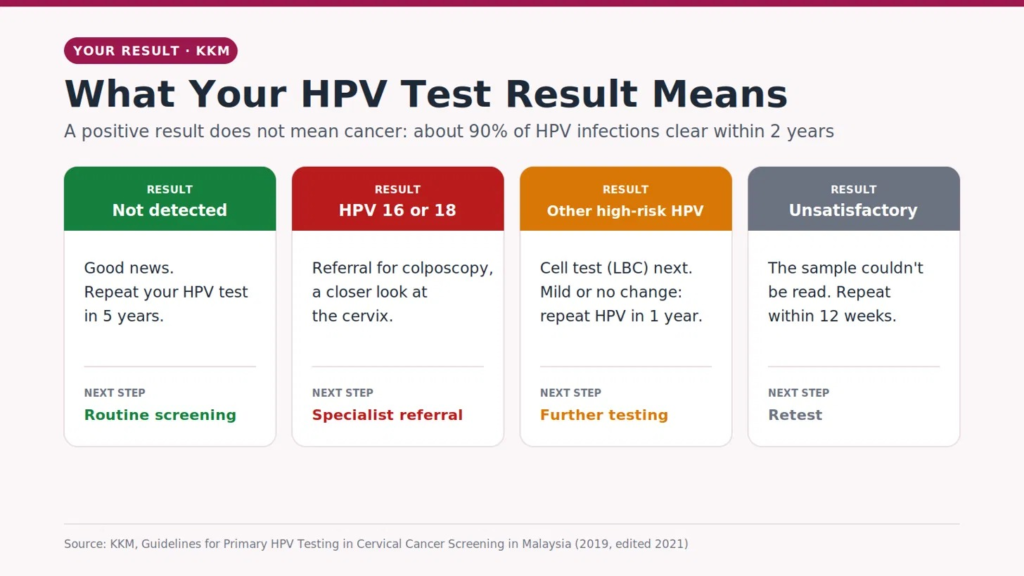
A positive HPV test does not mean you have cancer. HPV is very common, and about 90% of infections clear on their own within 2 years. Only infections that persist for years carry real risk, which is why the test is so useful: it finds the women who need closer follow-up.
| Your result | What happens next (KKM guideline) |
| HPV not detected (negative) | Repeat screening in 5 years |
| HPV 16 or 18 detected | Referral for colposcopy, a closer look at the cervix with a magnifying instrument |
| Other high-risk HPV detected (not 16 or 18) | A liquid-based cytology (cell) test on a cervical sample. If it shows no change or only mild change, repeat the HPV test in 1 year. If it shows more serious change, referral for colposcopy. |
| Unsatisfactory | Repeat test within 12 weeks |
Source: KKM, 2019.
If precancerous changes are found, they can usually be treated before they ever become cancer. After treatment, KKM advises a follow-up HPV test at 12 months, which can be done at your family clinic.
HPV Vaccination: The Other Half of Prevention
Screening finds problems early, while vaccination stops many of them from starting. Malaysia launched its national school-based HPV vaccination programme in 2010 for Form 1 girls, aged 13. A local study projected that the vaccine could prevent 89% of cervical cancers in Malaysia.
Coverage of Form 1 girls was above 90% before the pandemic, but fell to 14.3% in 2021. Girls in the 2022 and 2023 cohorts also missed their doses because of limited vaccine supply. Vaccination resumed in full in May 2024, with school health teams catching up on girls in Forms 1 to 4.
If your daughter missed her HPV vaccine, or you were never vaccinated yourself, ask your doctor about catch-up options. Being vaccinated does not replace screening. Vaccinated women should still have regular HPV tests.
Gardasil 9 Vaccination for Prevention
Prevention starts even before screening. We also offer the Gardasil 9 HPV vaccine, which protects against nine HPV types, including the high-risk types 16, 18, 31, 33, 45, 52 and 58. Ask our doctors whether it is right for you.
At Klinik Central SS15 and Taman Megah branches, we provide vaccines to prevent Human Papilloma Virus (HPV) and reduce the risk of cervical cancer.
Frequently Asked Questions
Is the HPV test better than a Pap smear? For women aged 30 to 65, yes. KKM notes that HPV DNA testing is more effective than the Pap smear at detecting precancerous changes, and a negative result means you can wait 5 years before your next test.
At what age should I get an HPV test in Malaysia? KKM recommends the HPV test for sexually active women aged 30 to 65. Women under 30 can be offered a Pap smear instead.
How often do I need an HPV test? Every 5 years if your result is negative.
Does a positive HPV test mean I have cancer? No. About 90% of HPV infections clear on their own within 2 years. A positive result means you need follow-up tests to check whether the cells on your cervix have changed.
Can I do the HPV test myself? Yes. KKM offers HPV self-sampling, where you collect a vaginal swab yourself in private. It does not need a speculum.
Is HPV testing free in Malaysia? Free HPV testing is available at KKM health clinics and at LPPKN’s Klinik Nur Sejahtera for eligible women aged 30 to 65.
Do I still need screening if I’ve had the HPV vaccine? Yes. The vaccine does not protect against every high-risk HPV type, so regular screening is still needed.
Book Your Screening Today
Cervical cancer is one of the few cancers that can be prevented almost entirely, through vaccination, regular screening and early treatment. If you are 30 to 65 and haven’t had an HPV test in the past 5 years, now is the time. Book a screening with our doctors at Klinik Central SS15 and Taman Megah. We will guide you through the test, explain your results and arrange follow-up if needed.
You can have a look at our health screening packages here!
References
• Family Health Development Division, Ministry of Health Malaysia.Guidelines for Primary HPV Testing in Cervical Cancer Screening in Malaysia (2019, edited May 2021)
• Ministry of Health Malaysia. Guidelines for Cervical Cancer Screening in Malaysia 2023
• Ministry of Health Malaysia. Press statement: Malaysia National Cancer Registry Report 2017–2021 summary (July 2024)
• ICO/IARC Information Centre on HPV and Cancer. Malaysia: Human Papillomavirus and Related Cancers, Fact Sheet 2023
• CodeBlue. Malaysia Makes Progress Towards Eliminating Cervical Cancer, But Challenges Persist
• Noor Mohamad et al. Cervical cancer in Malaysia. J Obstet Gynaecol Res 2024
• MyGOV. Cervical Cancer Screening Programme (HPV DNA Test) by LPPKN