Breast cancer is the most common cancer among Malaysian women, making up nearly 1 in 3 of all female cancers. October is Breast Cancer Awareness Month, also known as Pink October, a reminder that this cancer is far easier to treat when it is found early.
In Malaysia, too many cases are still found late. Half of all breast cancers with a recorded stage are diagnosed at stage III or IV. This guide covers the latest numbers, the early signs to watch for, what screening the Ministry of Health Malaysia (KKM) recommends at each age, and how to get a free mammogram.
Breast Cancer in Malaysia: The Latest Numbers
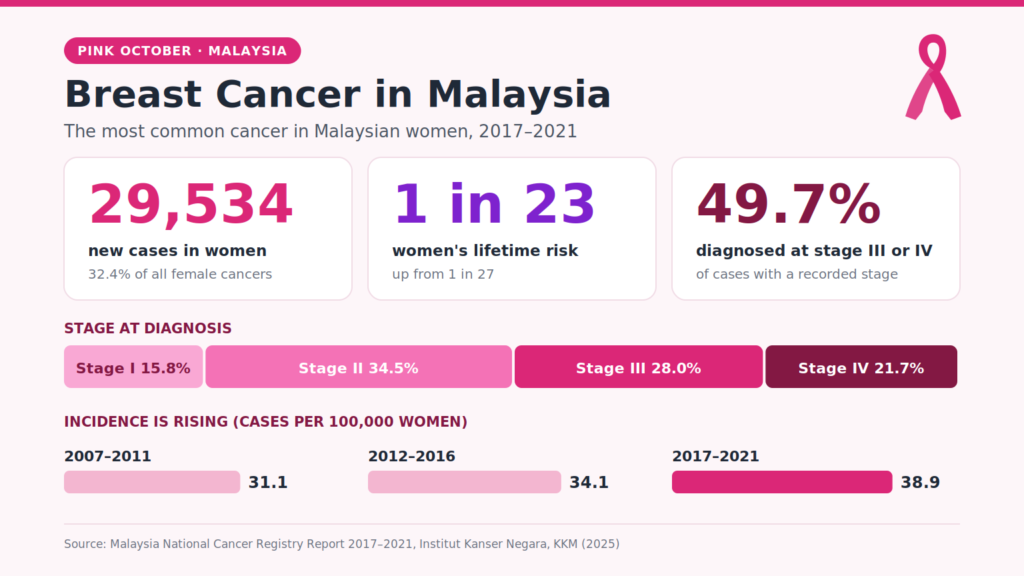
From 2017 to 2021, 29,534 Malaysian women were diagnosed with breast cancer, which is 32.4% of all cancers in women. The incidence is rising, and 1 in 23 Malaysian women will develop breast cancer in her lifetime, up from 1 in 27 in the previous report.
| Key figure | Value |
| New cases in women, 2017–2021 | 29,534 |
| Share of all cancers in women | 32.4% (the most common) |
| Lifetime risk | 1 in 23 women (previously 1 in 27) |
| Diagnosed at stage III or IV | 49.7% of cases with a recorded stage |
| Age at which incidence starts to rise | 25 years, peaking at 65 to 69 |
Source: Malaysia National Cancer Registry Report 2017–2021, Institut Kanser Negara, KKM (published December 2025).
The incidence rate has climbed steadily across three national reports, from 31.1 to 34.1 to 38.9 cases per 100,000 women (2007–2011, 2012–2016 and 2017–2021). Breast cancer also tends to strike Malaysian women younger than in Western countries: about half of patients are diagnosed before age 50.
Stage at diagnosis, 2017–2021
| Stage | Share of cases |
| Stage I | 15.8% |
| Stage II | 34.5% |
| Stage III | 28.0% |
| Stage IV | 21.7% |
Only about 1 in 6 cases is caught at stage I, when treatment is simplest and most successful. Regular screening is how that number goes up.
Lifetime risk by ethnicity
| Ethnic group | Lifetime risk |
| Indian | 1 in 17 |
| Chinese | 1 in 19 |
| Malay | 1 in 26 |
| Other Bumiputera | 1 in 45 |
Source for both tables: MNCR 2017–2021.
7 Early Signs of Breast Cancer
See a doctor if you notice any of these changes. Signs 1 to 4 are the ones KKM’s breast health leaflet lists; signs 5 to 7 are other common warning signs doctors check for:
- A new lump in the breast or armpit
- A change in the size or shape of the breast
- A nipple that turns or pulls inward
- Discharge from the nipple that comes out on its own, especially if it stains your clothes
- Thickening or swelling in part of the breast
- Skin changes, such as dimpling, puckering or redness
- Pain in one spot that does not go away
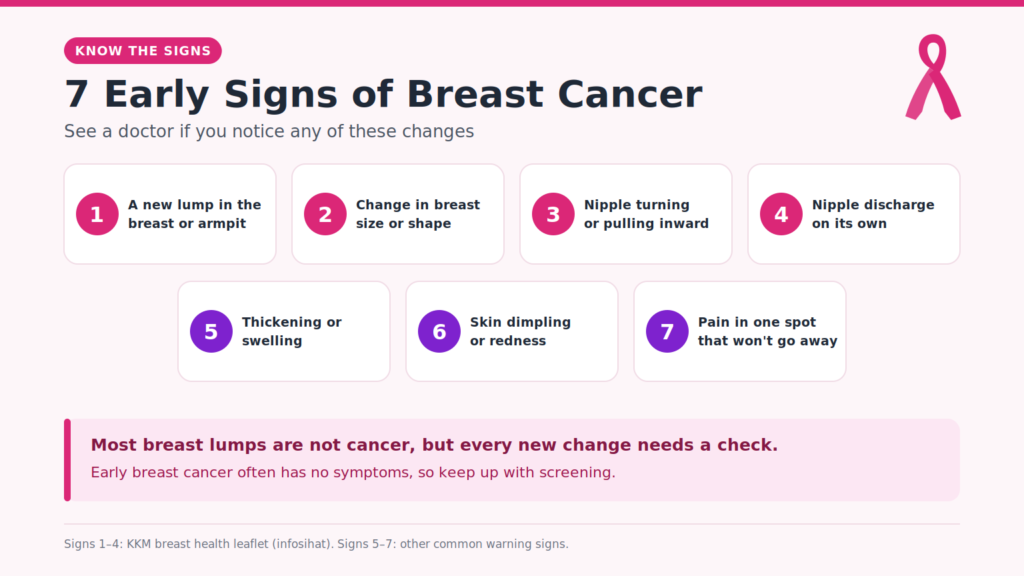
Most breast lumps are not cancer, but every new change should be checked by a doctor. Early breast cancer often causes no symptoms at all, which is why screening matters even when you feel well.
Who Is at Higher Risk?
Any woman can get breast cancer, including women with no family history. Some factors raise the risk:
Factors you cannot change
- Age. Risk rises with age. In Malaysia, incidence starts climbing from 25 and peaks at 65 to 69.
- Family history. KKM’s risk assessment looks at relatives with breast cancer, how young they were when diagnosed, cancer in both breasts, and male relatives with breast cancer.
- Inherited gene changes, such as BRCA1, BRCA2 or PALB2.
- A previous breast cancer.
- Longer lifetime exposure to hormones, such as starting periods early or reaching menopause late.
Factors you can change
- Obesity, especially after menopause
- Long-term hormone replacement therapy after menopause
- Alcohol and smoking
If breast or ovarian cancer runs in your family, talk to your doctor. KKM’s guideline recommends earlier and more frequent screening for women at higher risk.
Wired vs Wireless Bras: Do They Affect Breast Cancer Risk?
No. Wearing a bra, wired or wireless, does not cause breast cancer. This is one of the most common breast cancer myths in Malaysia and around the world.
A 2014 study published in Cancer Epidemiology, Biomarkers & Prevention compared 1,044 women aged 55 to 74 with breast cancer against 469 women without it. It found no link between bra wearing and breast cancer risk (UW School of Public Health). The risk was the same no matter how many hours a day women wore a bra, whether it had an underwire, or how young they were when they started wearing one (Breastcancer.org).
The myth may persist because being overweight does raise breast cancer risk, and women who are overweight are more likely to have larger breasts and wear a bra. It is the weight, not the bra, that matters.
How wired and wireless bras compare
| Wired bra | Wireless bra (including sports and soft bras) | |
|---|---|---|
| How it works | A thin, curved wire sewn under each cup gives a firm frame | Support comes from the band, fabric and seams, with no wire |
| Main benefit | More lift, shape and separation, often preferred by women with larger breasts | Softer and more comfortable; some women have less breast pain in a wireless bra |
| Good for | Everyday wear and fitted clothing | Exercise, lounging, sleeping and days with breast tenderness |
| Watch out for | A wire that digs in, pokes out or sits on breast tissue usually means the size is wrong | Too little support can cause discomfort during exercise or for larger breasts |
| Effect on breast cancer risk | None | None |
Why the right fit matters
The type of bra matters less than how well it fits. A bra that doesn’t fit is one of the most common causes of breast discomfort, and it can also contribute to back, shoulder, chest and neck pain (Alberta Health Services). A well-fitting bra should:
- Feel comfortable, with a band that stays level and doesn’t ride up your back
- Have straps that don’t dig into your shoulders
- Hold your breasts fully in the cups, without spilling over the top or into the armpits
- Sit flat against your breastbone at the centre
- If it is wired, have a wire that lies flat against your body and doesn’t dig in
If breast pain bothers you, try a sports bra or a wireless bra. If the pain wakes you at night, a soft sports bra may help when you sleep. Re-check your size once a year, and whenever your weight changes or you are pregnant or breastfeeding.
The takeaway: choose the bra that fits well and feels comfortable for you. No bra protects against or causes breast cancer. What makes the real difference is knowing your normal, acting on changes early, and getting screened. Any new lump, or breast pain that doesn’t go away, should be checked by a doctor, whatever bra you wear.
Breast Cancer Screening: What KKM Recommends by Age
For women at average risk, KKM recommends a mammogram every 2 years from age 50 to 74, a clinical breast examination by a doctor or nurse, and monthly breast self-examination from age 20.
| Age | Breast self-examination | Clinical breast examination | Mammogram |
| 20 to 39 | Every month | Every 3 years | Not routine |
| 40 to 49 | Every month | Every year | Not routine, but available if you wish or are at higher risk |
| 50 to 74 | Every month | Every year | Every 2 years |
Sources: MOH CPG Management of Breast Cancer (3rd edition, 2019) and KKM National Guideline for the Early Detection of Breast Cancer Programme (2011), as summarised by Htay et al., 2024.
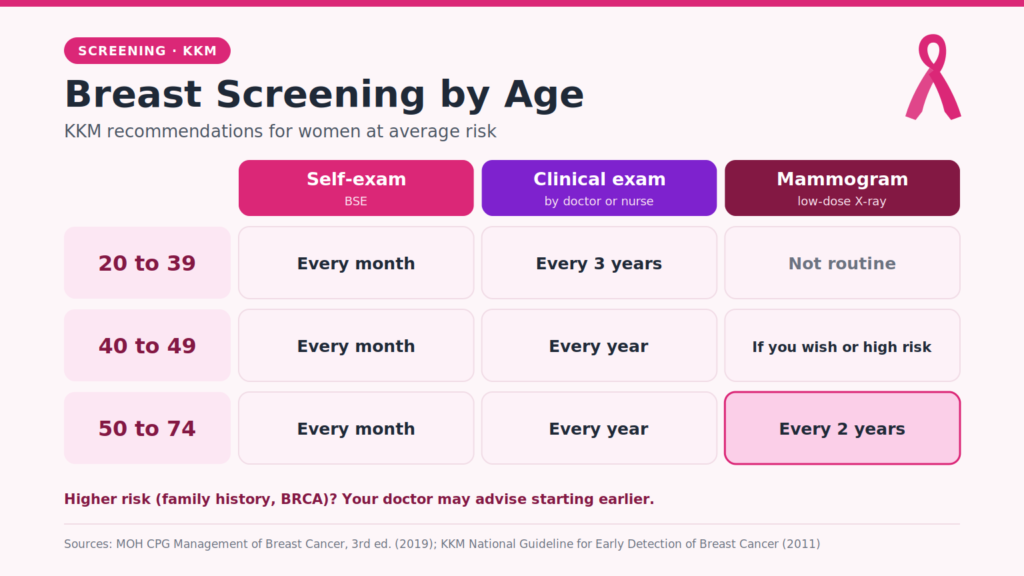
Women at higher risk may start earlier. KKM’s guideline suggests that high-risk women consider a yearly mammogram from age 30 to 39, have one every year from 40 to 59, and every 2 years from 60. Known BRCA1, BRCA2 or PALB2 carriers may also need a yearly MRI from age 30. Your doctor can work out your risk level and the right plan for you.
A mammogram is a low-dose X-ray of the breast. It can find cancers that are too small to feel, often years before any symptoms appear.
Breast Awareness Month Special at Klinik Central
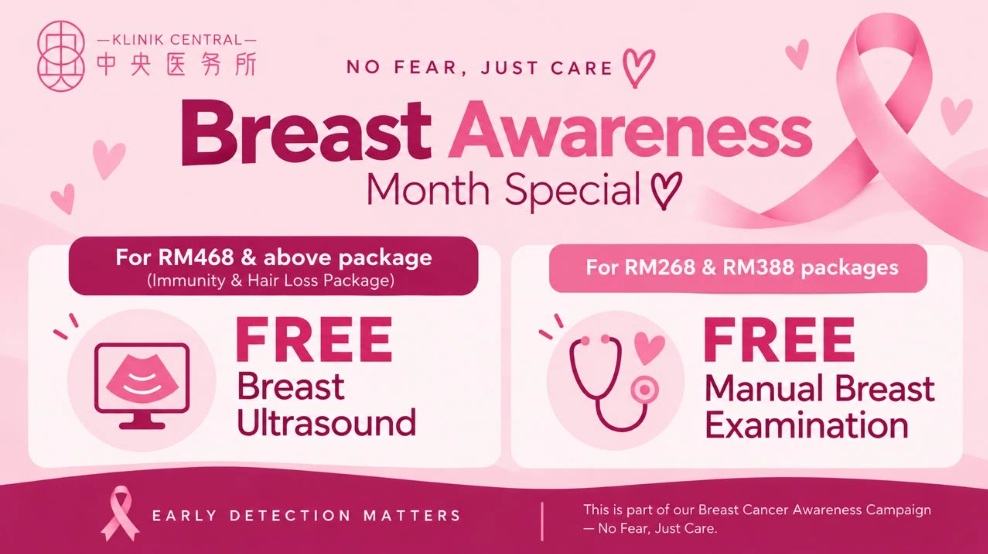
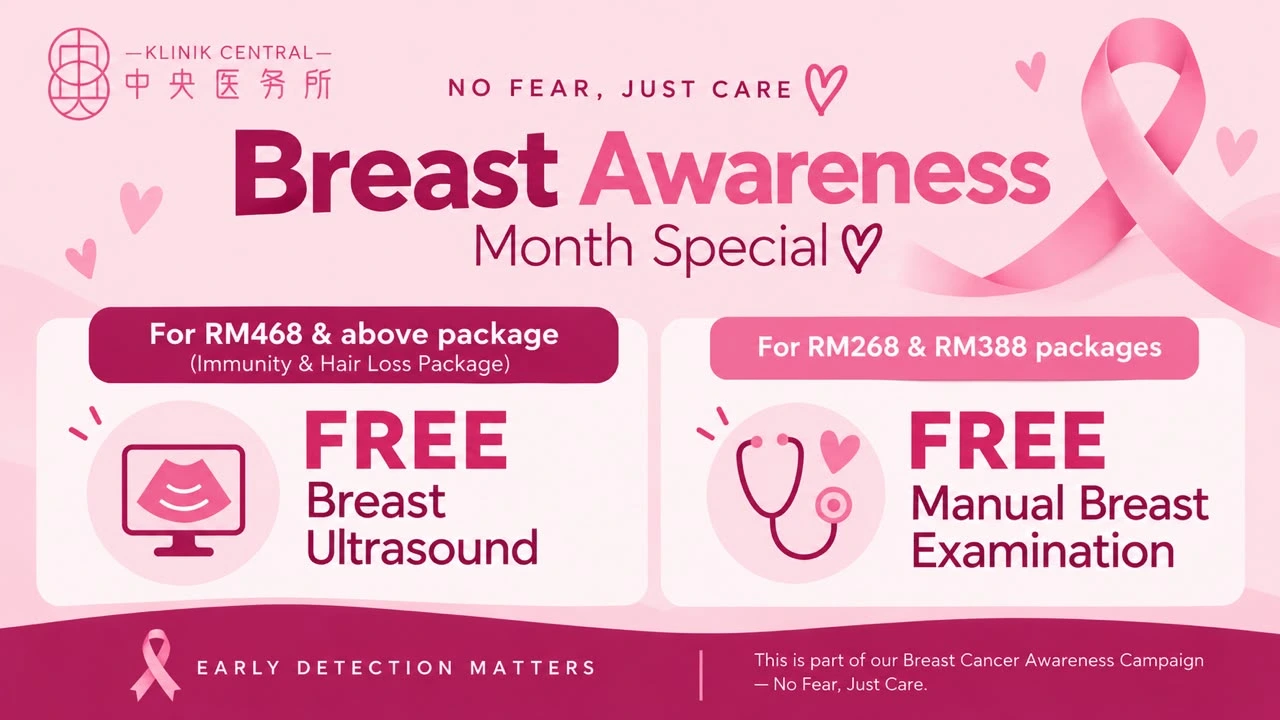
As part of our Breast Cancer Awareness Campaign, No Fear, Just Care, Klinik Central is adding a free breast check to selected health packages this October.
| Health package | Free with your package |
|---|---|
| RM468 and above (Immunity & Hair Loss Package) | Breast ultrasound |
| RM268 and RM388 packages | Manual breast examination by our doctor |
A breast ultrasound uses sound waves, not radiation, to look at breast tissue. A manual breast examination is a clinical breast exam, where the doctor checks your breasts and armpits for lumps or other changes. Neither replaces a screening mammogram for women aged 50 to 74, so our doctors will also tell you whether you are due for one.
Early detection matters. Ask our team about the packages when you book.
You can take a look at our health screening packages here!
Free Mammograms in Malaysia: The LPPKN Subsidy
Need a mammogram? We don’t offer mammograms at Klinik Central, but eligible women aged 35 to 70 can get one free through LPPKN’s subsidy programme. Our doctors can check whether you’re due and help you get started.
Eligible women can get a free mammogram through the Mammogram Subsidy Programme run by LPPKN under the Ministry of Women, Family and Community Development (KPWKM). The programme has been running since May 2007.
| Requirement | Detail |
| Who | Malaysian citizens or permanent residents aged 35 to 70 |
| Priority | Women at high risk of breast cancer, women referred for a diagnostic mammogram, follow-up mammograms under the programme, and screening before starting hormone replacement therapy |
| Cost, household income RM10,000 or less | Free |
| Cost, household income above RM10,000 | RM50 subsidy per test |
| How to apply | Visit a Klinik Nur Sejahtera LPPKN or register at mamogram.lppkn.gov.my |
Source: Ihsan MADANI (updated October 2026). Government clinics and hospitals also offer mammograms for a nominal fee.
How to Do a Breast Self-Examination
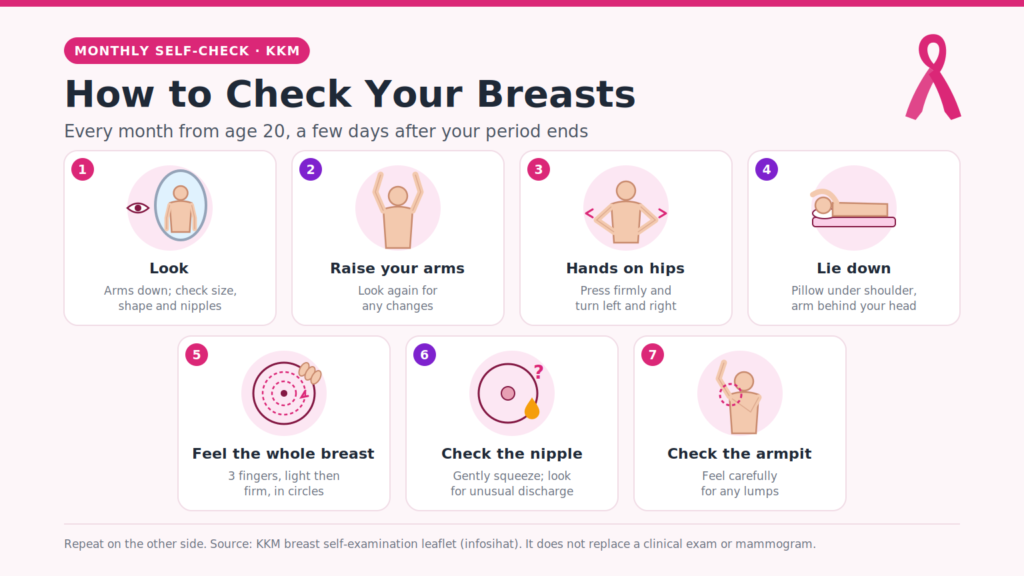
KKM asks all women aged 20 and above to check their breasts once a mont. Pick the same time each month. If you still have periods, a few days after your period ends is best, because your breasts are less tender then.
1. Look in the mirror. Undress to the waist with your arms by your sides. Check the size, shape and symmetry of both breasts and the level of your nipples.
2. Raise your arms and tense your chest. Lift your arms overhead, then press your hands firmly on your hips. Turn left and right and look for any change.
3. Lie down. Put a pillow or folded towel under your right shoulder and place your right arm behind your head.
4. Feel the whole breast. Using the pads of the three middle fingers of your left hand, check the right breast in up-and-down strips or small circles. Cover the area from your collarbone to your bra line, and from the middle of your chest to your armpit. Go over it once with light pressure and once with firm pressure.
5. Check the nipple. Gently squeeze the nipple and look for any unusual discharge.
6. Check your armpit. Lower your arm and feel your armpit carefully for lumps.
7. Repeat on the other side.
A self-exam helps you learn what is normal for you, so you notice changes early. It does not replace a clinical breast examination or a mammogram.
Frequently Asked Questions
How common is breast cancer in Malaysia? Breast cancer is the most common cancer in Malaysian women, making up 32.4% of all female cancers from 2017 to 2021. About 1 in 23 Malaysian women will develop it in her lifetime.
When should I start having mammograms in Malaysia? KKM recommends a mammogram every 2 years for women aged 50 to 74 at average risk. Women at higher risk may need to start earlier, so ask your doctor.
Is a lump in the breast always cancer? No. Most breast lumps are not cancer, but every new lump should be checked by a doctor.
How often should I check my own breasts? KKM advises all women aged 20 and above to do a breast self-examination once a month.
Can I get a free mammogram in Malaysia? Yes. LPPKN’s Mammogram Subsidy Programme offers free mammograms to eligible women aged 35 to 70 with a household income of RM10,000 or less, and a RM50 subsidy above that.
Can young women get breast cancer? Yes. About half of Malaysian breast cancer patients are diagnosed before age 50, which is younger than in many Western countries.
Can men get breast cancer? Yes, though it is rare. 185 cases in men were recorded in Malaysia from 2017 to 2021.
Take One Step This Pink October
Breast cancer found early is far easier to treat. This month, check your breasts, learn what is normal for you, and book the screening that fits your age. Our doctors at [Clinic name, area, Selangor] can do a clinical breast examination, assess your risk, and refer you for a mammogram, including through the LPPKN subsidy if you are eligible.
References
- National Cancer Registry, Institut Kanser Negara, Ministry of Health Malaysia. Malaysia National Cancer Registry Report 2017–2021 (December 2025)
- Ministry of Health Malaysia. Clinical Practice Guidelines: Management of Breast Cancer, 3rd edition (2019)
- Ministry of Health Malaysia. Garis Panduan Program Pengesanan Awal Kanser Payudara Kebangsaan (2011)
- Kementerian Kesihatan Malaysia. Breast self-examination leaflet (infosihat)
- Htay MNN, Su TT, Donnelly M. Risk-Stratified Breast Cancer Screening in Malaysia: Challenges and Opportunities. Asian Pac J Cancer Prev 2024; 25(3): 785–791
- Ihsan MADANI. Program Subsidi Ujian Mamogram (updated 12 October 2026)
- LPPKN. eMAMOGRAM portal