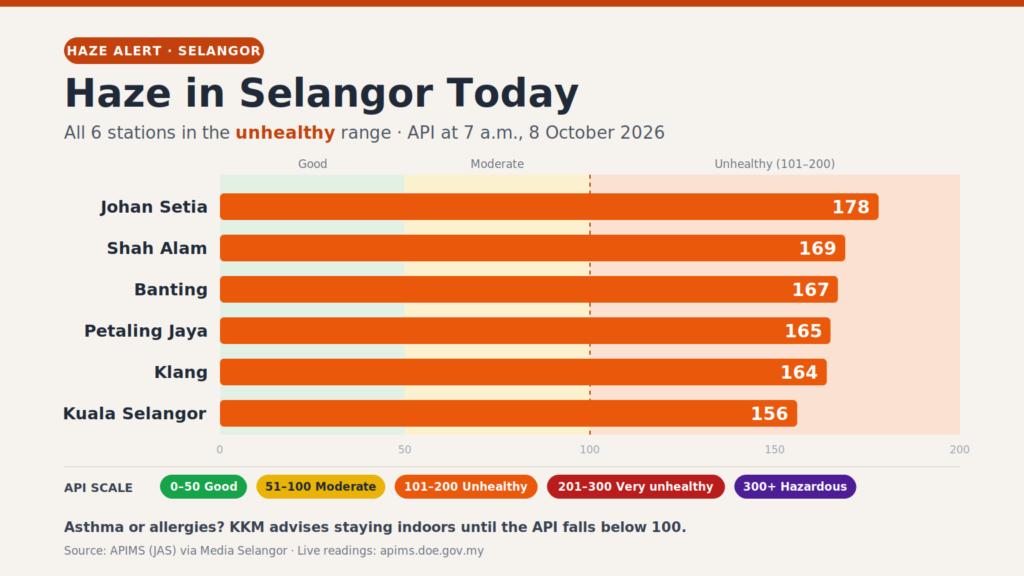
Haze and asthma are a risky mix, and this season, Selangor is feeling it. On the morning of 8 October 2026, all six air-quality stations in Selangor recorded “unhealthy” Air Pollutant Index (API) readings, with Johan Setia the highest at 178.
For people living with asthma, allergic rhinitis or other respiratory allergies, haze particles can trigger coughing, wheezing, sneezing and breathlessness within hours. The Ministry of Health Malaysia (KKM) lists people with asthma, chronic lung disease and allergies among the groups at highest risk. This guide explains what today’s API numbers mean and the practical steps KKM recommends to keep you and your family breathing easier.
Haze in Selangor Today: The Latest API Readings
Every monitoring station in Selangor is in the unhealthy range (API 101–200) as of 7 a.m. on 8 October 2026. Nationwide, 38 areas recorded unhealthy readings that morning.
| Selangor station | API, 8 Oct 2026, 7 a.m. | Status |
| Johan Setia (Klang) | 178 | Unhealthy |
| Shah Alam | 169 | Unhealthy |
| Banting | 167 | Unhealthy |
| Petaling Jaya | 165 | Unhealthy |
| Klang | 164 | Unhealthy |
| Kuala Selangor | 156 | Unhealthy |
Source: APIMS data reported by Media Selangor.
Air quality has swung quickly this month. On 3 October, every Selangor station was only moderate, with Johan Setia at 73. By 7 October, Johan Setia had climbed to 189 and Shah Alam to 179.
The health impact is measurable. KKM sentinel clinics recorded 1,811 asthma cases in epidemiological week 34 (23–29 August), up from 219 the week before. That is more than an eightfold rise in one week.
What the API Numbers Mean for Asthma Patients
Malaysia’s API has five bands, set by the Department of Environment (JAS) and published on the official APIMS portal.
| API | Status | What it means if you have asthma or allergies |
| 0–50 | Good | Normal activities |
| 51–100 | Moderate | Watch for symptoms; keep your reliever inhaler with you |
| 101–200 | Unhealthy | Limit outdoor activity; wear a suitable mask if you must go out |
| 201–300 | Very unhealthy | Stay indoors; schools, kindergartens and nurseries must close above 200 |
| Above 300 | Hazardous | Stay indoors and follow official instructions |
KKM’s haze guidance advises people with chronic conditions such as asthma to avoid going outdoors until the API drops below 100. JAS has reminded that schools, kindergartens and nurseries must close immediately when the API exceeds 200.
How Haze Triggers Asthma and Respiratory Allergies
Haze irritates already-sensitive airways, so symptoms can flare even in people whose asthma is usually well controlled. The API is calculated from fine dust particles (10 microns and smaller) plus gases such as carbon monoxide, sulphur dioxide, nitrogen dioxide and ozone.
KKM lists these common effects of prolonged haze exposure:
• Itchy throat and coughing
• Difficulty breathing or shortness of breath
• Stinging, watery eyes
• Runny nose and frequent sneezing
• Itchy skin
• Chest pain
Those at highest risk include children, older adults, smokers, outdoor workers, and anyone with asthma, bronchitis, chronic lung disease, heart disease or allergies.
Haze and Asthma: 7 KKM-Backed Steps to Protect Your Lungs
These steps follow KKM’s A-B-C-D-E haze advice and the national asthma guideline.
1. Check the API before you step out. Look up your nearest station on APIMS every morning and before outdoor plans. KKM calls this being cakna (alert) to air quality.
2. Cut outdoor activity when the API passes 100. KKM advises reducing or avoiding outdoor physical activity at unhealthy levels. People with asthma should stay indoors until the API falls below 100. Move exercise indoors.
3. Wear the right mask if you must go out. KKM recommends a suitable mask such as an N95. KKM also notes N95 masks can cause discomfort or breathing difficulty for some people with asthma or heart disease, so ask your doctor which mask suits you.
4. Keep taking your asthma medicines and follow your action plan. Do not stop your preventer inhaler because you feel fine. The MOH Clinical Practice Guideline Management of Asthma in Adults (2nd edition, 2024) recommends every patient have a written asthma action plan that guides when to adjust medication. Carry your reliever at all times.
5. Drink enough plain water. KKM advises staying well hydrated with boiled or plain water during haze.
6. Rinse off haze particles. Wash your face and any exposed skin with clean water after being outdoors, as KKM advises.
7. Stop smoking and avoid second-hand smoke. KKM advises smokers to quit, and smoke adds to the irritation haze already causes.
Warning Signs: When to See a Doctor Immediately
KKM advises going to the nearest health facility straight away if you develop shortness of breath, a persistent cough or eye irritation. Seek care promptly if you notice:
• Breathlessness, wheezing or chest tightness that your reliever inhaler does not ease
• Needing your reliever more often than your action plan allows
• Chest pain
• A cough that will not settle, or a sore throat with stinging eyes
• Any existing condition (asthma, chronic lung disease, heart disease) getting worse
If someone is struggling to speak, turning blue around the lips, or becoming drowsy, call 999 immediately.
Frequently Asked Questions
What API level is unsafe for people with asthma in Malaysia?
An API above 100 is unhealthy. KKM advises people with asthma to stay indoors until the API falls below 100.
Is an N95 mask safe for asthma patients during haze?
KKM recommends an N95 for anyone who must be outdoors, but notes it can cause discomfort for some people with asthma. Ask your doctor before relying on one.
Where can I check the haze level in Selangor today?
Use the Department of Environment’s official APIMS portal at apims.doe.gov.my. It lists hourly readings for Shah Alam, Klang, Petaling Jaya, Johan Setia, Banting and Kuala Selangor.
When does haze season usually happen in Malaysia?
Haze is usually worst between June and October, when southwest monsoon winds carry smoke from regional fires.
Should I stop my asthma medicine if I feel fine during haze?
No. Keep taking your preventer as prescribed and follow your written asthma action plan, as recommended in the MOH asthma guideline.
Breathe Easier This Haze Season
Haze season does not have to mean an asthma attack. Check the API daily, stay indoors when it passes 100, keep your medicines on track and act early on warning signs. If you do not yet have a written asthma action plan, or your symptoms have worsened since the haze began, book a review with our doctors at Klinik Central SS15 and Taman Megah today.
References
• Kementerian Kesihatan Malaysia.Panduan Kesihatan untuk Anda (haze health guide)
• Pejabat Kesihatan Daerah Segamat, KKM. 5 Langkah A-B-C-D-E semasa musim jerebu (September 2026)
• MaHTAS, MOH. CPG Management of Asthma in Adults, 2nd edition (2024)
• Jabatan Alam Sekitar. APIMS live air quality portal
• Media Selangor. Jerebu: Enam kawasan di Selangor catat IPU tidak sihat (8 October 2026)
• Media Selangor. Jerebu: IPU Selangor masih sederhana (3 October 2026)
• Utusan Malaysia. Kes asma meningkat lebih lapan kali ganda susulan jerebu (29 August 2026)
• Pekhabar. Jerebu Malaysia 2026 (seasonal pattern, June–October)